
Window film marketing is full of claims about “infrared rejection”. Those numbers often say very little about how much heat a film actually keeps out of your home. Here is why, and which number to look at instead.
The problem with “IR rejection”
The window industry has no formally recognized measurement of infrared rejection. So some manufacturers, 3M in particular, publish “IR rejection” values measured at a single wavelength or over a narrow range, usually where their film performs best. But solar infrared energy spans a wide range, from about 780 to 2,500 nanometers, and the energy in it varies enormously across that range. Measuring one point or a small slice captures only part of the heat, not the whole picture, and it ignores the effect of absorption entirely.
A quick primer on solar energy
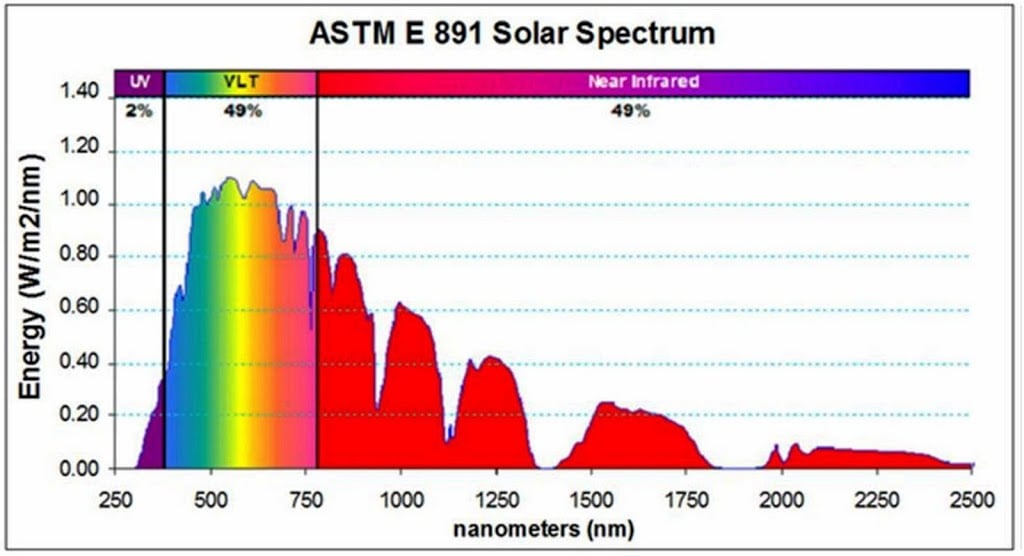
Sunlight reaching the ground is made up of three parts:
- Ultraviolet (UV), roughly 100 to 380 nm: invisible and highly destructive (sunburn, skin cancer, fading), but only about 2% to 3% of the sun’s energy, so it adds little heat.
- Visible light, about 400 to 780 nm: roughly half of the sun’s energy, and a large share of the heat. When visible light hits a surface, that surface heats up.
- Near infrared (NIR), about 780 to 2,500 nm: the other half of the sun’s energy, and slightly more than half of its heat. Infrared beyond 2,500 nm is a tiny share of sunlight and is mostly heat given off by warm objects. So the NIR band that matters is about 1,720 nm wide.
The number that matters: SHGC
The industry-recognized measure of how much heat a window lets in is the Solar Heat Gain Coefficient (SHGC), or its counterpart, Total Solar Energy Rejected (TSER). The test methods were developed by the National Fenestration Rating Council (NFRC), whose members include window manufacturers, suppliers and government agencies.
SHGC is recognized by the U.S. government and federal energy laboratories, Energy Star, ASHRAE, the International Window Film Association, AIMCAL, the Air Conditioning Contractors of America, consumer groups and many others. Building codes, energy simulations and Energy Star ratings all use it, and so do many utility rebate programs for window film. Look at the windows in any home improvement store and you’ll find an NFRC label reporting SHGC.
SHGC counts two kinds of heat gain:
- radiation transmitted straight through the glass into the room
- radiation absorbed by the window and then re-radiated into the room
Some films and coatings, 3M Prestige among them, work largely by absorption. They block radiation by turning it into heat in the glass, and the more a window absorbs, the more of that heat it re-radiates inside as it warms up. SHGC already includes infrared, so pulling infrared out as a separate number is misleading.
Measurement follows ASTM E903, using a spectrophotometer across the entire spectrum, with absorption calculated under standard NFRC conditions. Crucially, each wavelength is weighted by how much solar energy it actually carries, rather than treating them all as equal.
How “IR rejection” numbers get cherry-picked
Because there is no standard, films with similar “IR rejection” claims can have very different SHGC values. Real examples of how manufacturers report it:
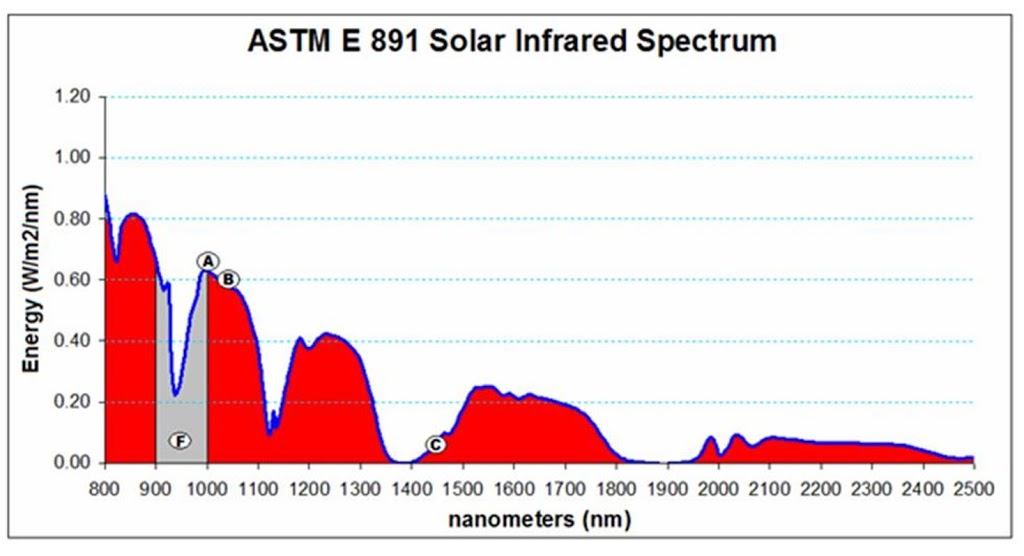
- Product A: one wavelength, 1,000 nm, where the sun’s energy has already tapered off significantly.
- Product B: one wavelength, 1,025 nm, which carries about 10% less energy than 1,000 nm.
- Product C: one wavelength around 1,450 nm, where almost no solar energy is left.
- Products D and E: no wavelength or range stated at all.
- Product F (3M Prestige): 900 to 1,000 nm only. That 100 nm is about 6% of the 1,720 nm infrared band, so the claim ignores 94% of infrared wavelengths.
The graph shows the sun’s energy across the near infrared at sea level. The highlighted segment is the narrow range Product F reports; the single points used by Products A, B and C are marked too. None of them represents the whole spectrum.
Transmission, reflection and absorption
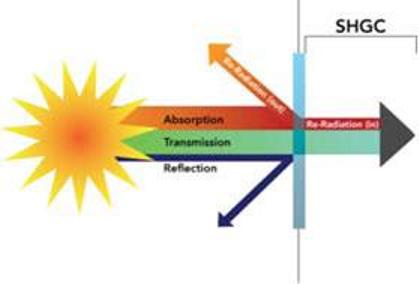
- Reflected energy never enters the glass or the building. It is sent away without heating either.
- Transmitted energy passes straight through and becomes heat inside.
- Absorbed energy heats the glass and frame. Some of it radiates back outdoors, and some of it comes inside.
SHGC accounts for all three. “IR rejection” figures only count what isn’t transmitted, and ignore the heat from absorbed energy.
The top window absorbs more than the bottom one, so it lets more heat into the home. “IR rejection” claims don’t capture this.

Reporting infrared honestly
If infrared performance is published at all, it should be weighted by the energy actually striking the glass, across the whole 780 to 2,500 nm range, as V-Kool already does. Energy at shorter wavelengths is far more intense than at longer ones: there is much more at 780 nm than at 2,000 nm. An unweighted figure ignores that.
What this means for you
- Compare films by SHGC or TSER, not by “IR rejection”.
- Spectrally selective films that reduce 94% to 98.3% of the whole infrared spectrum can give you more light with similar or better heat reduction than conventional or reflective films two to three times darker.
- V-Kool reflects more infrared than absorptive films like 3M Prestige. That means lower heat absorption, which makes it safer for dual-pane glass, and more heat reduction for its darkness, with a clearer view and less visible reflection.
Talk to one of our professionals and we’ll help you choose a film based on real performance numbers.
Call today! Local: 480-985-9293 · Out of Valley: 1-888-577-TINT (8468)
Made In The Shade Inc. Where YOU Are The COOLEST!
